

Five key takeaways for the market heading into 2026
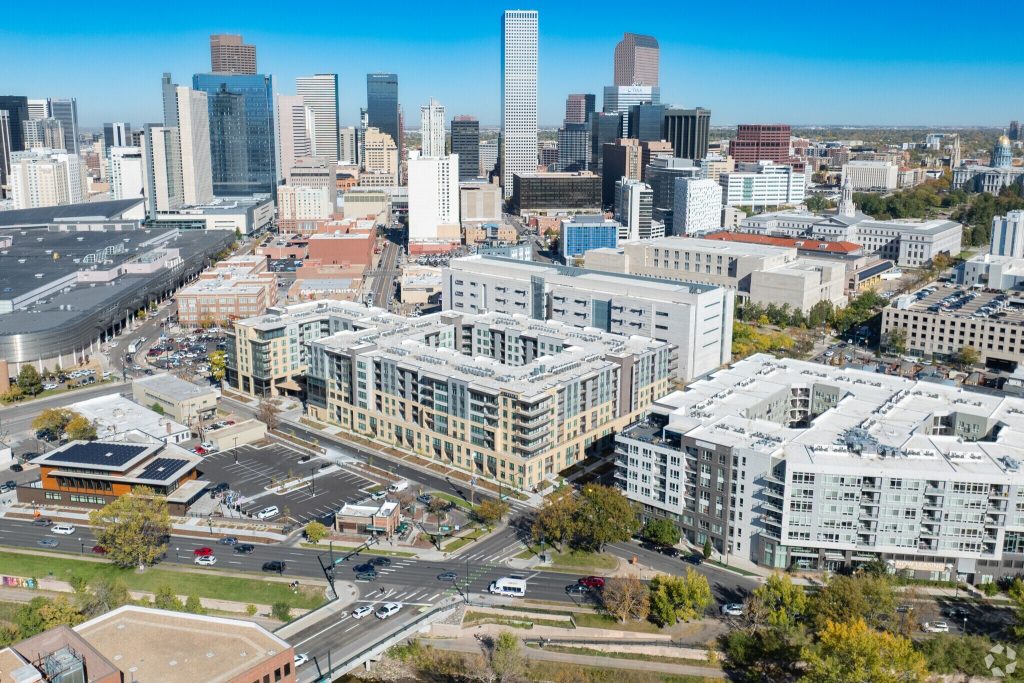
Denver developers completed over 12,000 units in 2025, including the 370-unit The Finch in the city’s Golden Triangle neighborhood. (CoStar)
CoStar Analytics
December 22, 2025 | 9:11 AM
Denver’s multifamily construction wave continues to pummel the market. Vacancies remain near record highs, dragging down rent growth as landlords face increased competition for renters.
However, construction is projected to decline sharply in the year ahead, setting the market up for a gradual recovery.
Multifamily rent growth has been under pressure this year due to an oversupply of units. Denver posted some of the steepest declines among major U.S. markets with rents contracting by 3.9% in 2025, according to CoStar data. Austin, Texas, was the only major market to outpace these rent losses, at negative 4.9% for the year.
Nearly all areas of the Denver market are reporting negative annual rent growth. The steepest declines are occurring in construction-heavy areas like Aurora and East Denver, where rents are down more than 4% from the previous year.
Looking ahead, CoStar forecasts that demand will outpace new supply in 2026. However, vacancies will likely remain high in the year ahead as the market contends with a significant supply overhang, and rents aren’t projected to return to the long-term benchmark until 2027.
Population growth in the Denver metropolitan area has moderated compared to the rapid expansion of the 2010s, when the region’s economic diversification into higher-paying industries attracted talent from across the country. The slowdown could further slow the apartment market’s recovery.
The region has grown 0.8% over the past year, compared to the pre-pandemic 10-year annual average of 1.6%. Denver’s higher cost of living has tempered growth, and domestic migration has shifted to affordable markets largely in the Sun Belt.
While population growth has slowed in recent years, the region continues to attract a younger demographic, largely due to the area’s outdoor and recreational lifestyle. Roughly 23.2% of Denver’s population is between 24 and 34 years old, according to Oxford Economic data. This younger demographic falls within prime renter years, helping to support demand for apartments.
Property managers note that generous, widespread concessions are primarily the reason leases are getting signed.
A record high 68% of Denver-area apartment buildings offered concessions in November, surpassing the national average of 44%. Renters can expect up to 12 weeks of free rent on a one-year lease in new apartment complexes.
Concessions have also become increasingly common in stabilized properties, or those that are at least 90% leased or have been open for at least 18 months, as property managers focus on shoring up renewals.
Renters of high-end units continue to drive demand. With tenants now receiving up to 12 weeks of free rent on a one-year lease, some renters are taking advantage of the substantial discounts to upgrade their living conditions. Over the past 12 months, net absorption — the difference between move-ins and move-outs — in high-end, four- and five-star buildings totaled 10,000 units, resulting in all positive net absorption in the Denver market. Vacancy in this segment peaked in late 2024 and has since fallen by 130 basis points to 12.8%.
As more renters take advantage of incentives offered at the top end of the market, demand and rent growth have pulled back in midtier, three-star properties. Vacancy in this segment is expected to continue rising through 2026, ultimately peaking near 14.5% in early 2027.
In an encouraging sign for local landlords and property managers, apartment demand in the Denver area is expected to pull ahead of new supply in the year ahead. Roughly 3,700 units are scheduled to open in 2026, marking the lowest level of new supply dating back to 2013.
As broader economic uncertainty mounts, coupled with Denver’s slowdown in population growth, recovery is expected to be slow. Vacancies will likely remain high in the year ahead, and rents aren’t projected to return to the long-term benchmark until 2027.