

You’ve got big plans for 2026. But what you do this year could be the difference between a smooth sale and a stressful one. If you’re thinking of selling next spring (the busiest season in real estate), the smartest move you can make is to start prepping now. As Realtor.com says:
“If you’re aiming to sell in 2026, now is the time to start preparing, especially if you want to maximize the spring market’s higher buyer activity.”
Because the reality is, from small repairs to touch-ups and decluttering, the earlier you start, the easier it’ll be when you’re ready to list. And, the better your house will look when it’s time for it to hit the market.
Talk to any good agent and they’ll tell you that you can’t afford to skip repairs in today’s market. There are more homes for sale right now than there have been in years. And since buyers have more to choose from, your house is going to need to look its best to stand out and get the attention it deserves.
Now, that doesn’t mean you have to do a full-on renovation. But it does mean you’ll want to tackle some projects before you sell. Your house will sell if it’s prepped right. And you don’t want to be left scrambling in the spring to get the work done.
Because here’s the advantage you have now. If you start this year, you’ll be able to space those upgrades and fixes out however you want to. More time. Less stress. No sense of being rushed or racing the clock.
Whether it’s fixing that leaky faucet, repainting your front door, or finally replacing your roof, you can do it right if you start now. And you have the time to find great contractors without blowing your budget or paying extra for rushed jobs.
To figure out what’s worth doing and what’s not in your market, you need to talk to a local agent early. That way you’re not wasting your time or money on something that won’t help your bottom line. As Realtor.com explains:
“Respondents overwhelmingly agree that both buyers and sellers enjoy a smoother, more successful experience when they start early. In fact, a recent survey reveals that, for sellers, bringing a real estate agent into the process sooner can pay off significantly.”
A skilled agent can tell you:
And having that information up front is a game changer.
To give you a rough idea of what may come up in that conversation, here are the most common updates agents are recommending today, according to research from the National Association of Realtors (NAR):
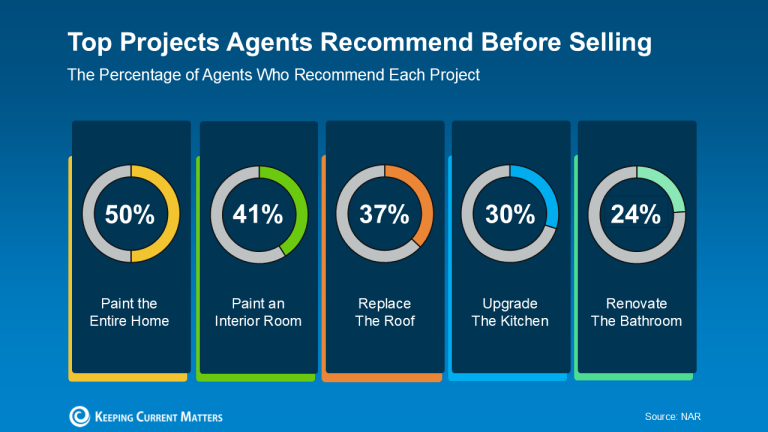
Just remember, what’s worth updating really depends on the homes you’re competing with in your market. Some areas don’t have a ton of inventory, so little updates may be all you need to tackle. In other areas, there are far more homes for sale, so you may need to do a bit more to make your house stand out.
Your agent will walk you through what you need to do for your specific house and market. And that’s expertise that’ll really pay off.
If 2026 is your year to sell, the work starts now. Taking some time to prep means you’ll hit the market confident, ready, and ahead of other sellers who waited until January to get started.
Want to know which projects are getting the biggest return on their investment in your market? Connect with a local agent so you can head into next spring with a solid game plan.

The original Opportunity Zone program is set to expire at the end of 2026, but that doesn’t mean it’s too late for the initiative to receive an upgrade.
The program, introduced during President Trump’s first term as part of the Tax Cuts and Jobs Act of 2017, will now see more than one-third of its designated areas classified as “rural.” That makes them eligible for a set of perks passed into law with this summer’s sweeping federal tax and spending legislation.
The Internal Revenue Service said in a notice released at the end of September that 3,309 of the 8,764 qualified opportunity zones that exist under the current program now qualify as “rural,” and the amount investors have to make to “substantially” improve a property is lowered from 100% of the investor’s investment in the property to 50%. Investors have 30 months to make the investment.
The IRS notice made it clear the new guidelines did not apply to the forthcoming and revamped Opportunity Zone program.
A list of all the zones that are now considered rural can be found here.
“It’s a pretty good deal,” said Dan Ryan, a partner at law firm Sullivan & Worcester who specializes in the Opportunity Zone program. “Hopefully it will help drive development in the rural areas.”
Even though the current program is winding down, Ryan stressed that organizations were still doing deals in designated opportunity zones even if they haven’t received all the benefits.
The benefits for investors putting their money into rural areas will carry forward into the new version of the program. In addition to existing Opportunity Zone benefits, investments are done on a rolling five-year deferral process. The new legislation retains the 10% step-up for five-year holdings but introduces a 30% step-up for investments in Qualified Rural Opportunity Funds.
That is in addition to the rule that would lower the “substantial improvement” threshold of existing structures from 100% to 50% in rural areas. Ryan said that could make these areas attractive to investors and developers that are interested in building new data centers.
“The need for new data centers are substantial and continue to go up,” Ryan said. “And they need space for those, and rural areas have space.”
The new program is set to go into motion soon. State governors are expected to name new opportunity zone areas by July 1, and the program would officially open for investment on January 1, 2027.
Experts have said business owners, landowners, investors and local governments should be preparing to engage with the new version of the program now, since the sunup to designating new zones is likely to be a time of intense lobbying.
That’s in large part because fewer areas will meet the qualifying criteria of the program in its second iteration. Congress narrowed the definition of “low-income community” to Census tracts with a poverty rate of at least 20% or a median household income that does not exceed 70% of the area median income. The current rules designate a low-income community as one with a poverty rate of at least 20% or a median household income of no more than 80% of an area’s median income.
States also previously were able to nominate a limited number of non-low-income tracts if they were contiguous to nominated low-income tracts and their median household income doesn’t exceed 125% of that neighboring low-income community’s median income. Under the new program, the term “low-income community” would not include any Census tract where the median household income is 125% or greater of the area median income.
The federal government has not yet published an official list of eligible tracts under the new law, but according to an analysis by The Business Journals of census tracts and the most recently available poverty data, about 26,000 tracts could meet the eligibility criteria for an Opportunity Zone designation under the parameters of the revamped program.
If governors were to then pick the maximum-allowed 25% of those sites to be Opportunity Zones, that would mean about 6,500 zones in the program — a nearly 26% drop from the number of available sites in the program’s first iteration. The original program found 42,176 census tracts eligible to be opportunity zones, with governors ultimately picking 8,764.
The projected figure is in line with other estimates that have found the number of eligible opportunity zones could fall by more than 20% under the new law. The Business Journals mapped out the potential census tracts that could be eligible.
Another key difference will be enhanced transparency, Ryan said, with the new law requiring more reporting and more data. That will help build trust and visibility in a program that had less openness the first time around.
“It’s going to make the whole process more transparent and by doing so it will build public support,” Ryan said. “This has overall been a net benefit to low-income areas.”

In an encouraging sign for local landlords and property managers, apartment demand in the Denver area pulled ahead of new construction for the first time in three years.
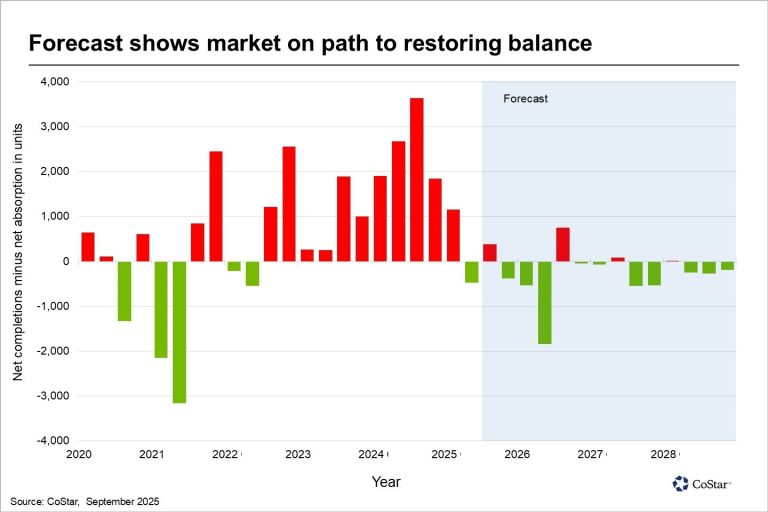
After 11 consecutive quarters of rising vacancy rates, renters leased about 475 more apartments than developers completed in the second quarter, CoStar data shows.
While Denver’s apartment market has likely turned a corner, the recovery is expected to be slow.
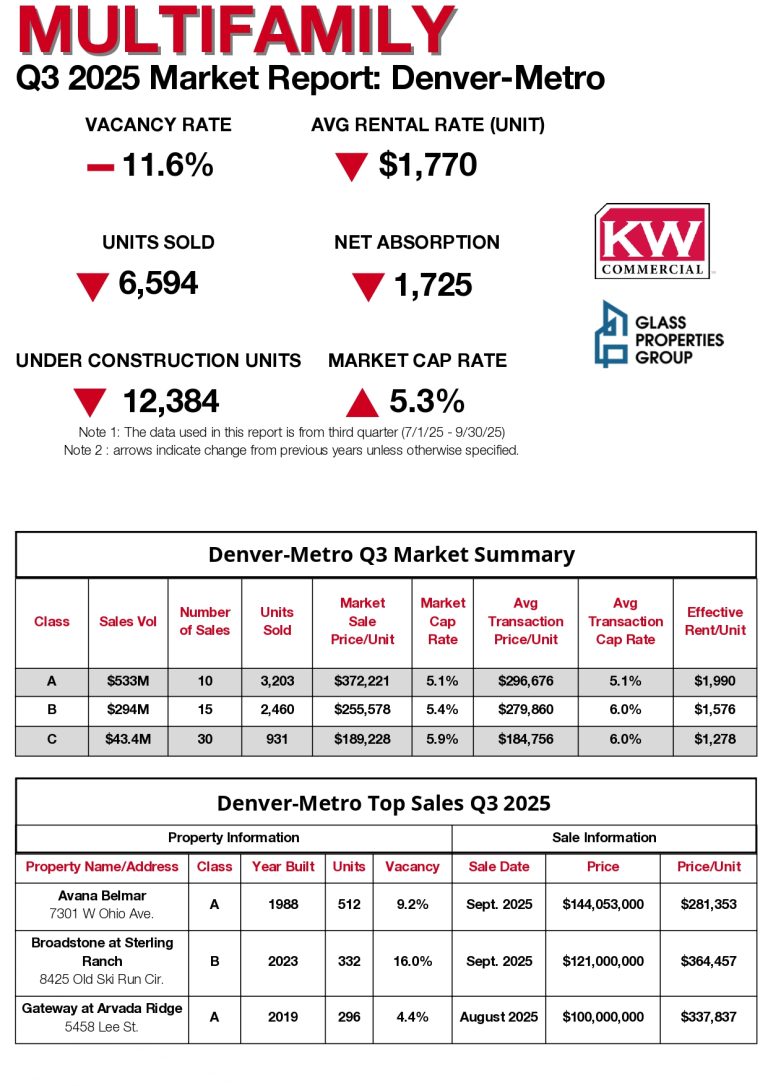
More than 51,000 apartments were developed from the second quarter of 2021 through the second quarter of 2025. During that time, net absorption — the difference in move-ins and move-outs — totaled roughly 30,500 units. This created a surplus of 20,500 units, increasing the overall vacancy rate from 5.5% midway through 2021 to the peak of 11.6% at the start of 2025.
However, an improving supply and demand balance brought vacancies down to 11.3% at the end of the second quarter, according to CoStar.
Another 12,200 units are in the pipeline. While the construction wave has cooled from the peak of 32,000 units underway in early 2023, the remaining units under construction will likely keep vacancies elevated in the near term as they are added to the market.
The elevated vacancy rate has forced Denver-area landlords to lower rents and offer generous concessions to compete for renters. Overall, rents are down 0.1% from the start of the year through the end of August.
Widespread concessions, such as several months of free rent, are largely the reason leases are getting signed, property managers have noted. Typically, concessions are limited to apartment complexes during lease-up, referring to properties that have been open for less than 18 months or haven’t reached at least 90% occupancy.
However, even stabilized properties are employing concessions as renters have more options than ever. Roughly half of Denver-area apartments are now offering some form of incentive.
Looking ahead, CoStar forecasts that supply and demand will end 2025 in equilibrium. However, vacancies will likely remain high this year, and rents aren’t projected to return to the long-term benchmark until 2026.
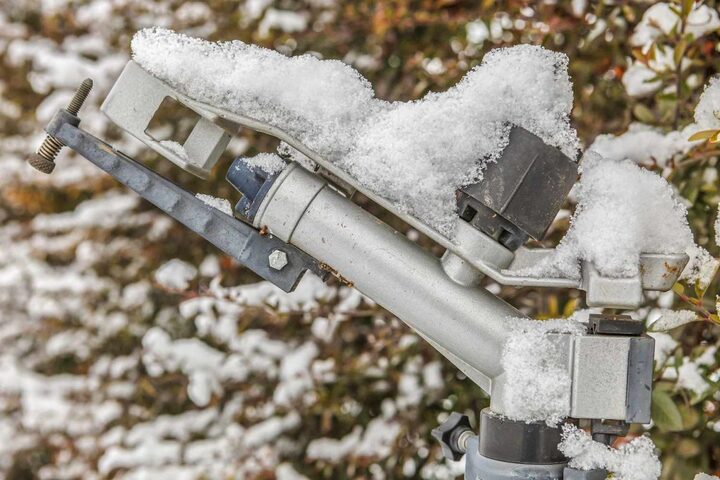
Colorado’s four-season climate brings plenty of beauty — but also a few homeowner responsibilities. One of the most important fall tasks is winterizing your sprinkler system. Skipping this step can lead to frozen pipes, burst lines, and costly repairs come spring. Here’s what every Colorado homeowner needs to know about blowing out their sprinklers and the right time to do it.
Our Colorado winters bring freezing temperatures that can quickly damage irrigation systems. Even a small amount of water left in your lines can freeze, expand, and crack:
Pipes – underground lines that are expensive to repair
Valves – critical for water control
Backflow preventers – one of the most vulnerable and costly parts to replace
A professional blowout uses compressed air to clear every last drop of water, ensuring your system stays intact through winter. Think of it as low-cost insurance against a much bigger repair bill.
Timing is everything. The first hard freeze along the Front Range usually arrives in late September to October. Higher elevations often see freezing temperatures earlier.
General guidelines:
Denver Metro (Aurora, Highlands Ranch, Boulder): Late September – Mid-October
Foothills & Mountain Communities (Evergreen, Conifer, Summit County): Early – Mid-September
Southern Colorado (Colorado Springs, Pueblo): Early – Mid-October
👉 Pro tip: Don’t wait for the freeze warning! By the time it’s on the forecast, contractors are already booked solid.
Turn off the system’s water supply
Connect an air compressor to the blowout port
Clear each zone with compressed air until only mist comes out
Shut down and disconnect, leaving valves slightly open for winter
Most homeowners prefer hiring a professional. The cost usually runs $60–$120 in the Denver area, depending on yard size and number of zones — far less than repairing frozen lines.
Book early: Sprinkler companies fill up fast in September and October
Protect your backflow preventer: It’s one of the most expensive components to fix
Mark your calendar: Add it to your annual fall home checklist (along with gutter cleaning and furnace servicing)
In Colorado, sprinkler blowouts aren’t optional — they’re essential. Schedule yours no later than mid-October in the Denver metro, and earlier in higher elevations. A quick appointment in the fall protects your system, your wallet, and your peace of mind.
👩💼 Need a Trusted Referral?
At Glass Properties Group, we keep a list of vetted local sprinkler professionals we trust for our clients and investment properties. Whether you’re winterizing your current home or preparing a rental property, we’re happy to connect you with reliable service providers.
📩 Contact us today for referrals — and stay ahead of Colorado’s next cold snap.




If you’ve been watching from the sidelines, now’s the time to lean in. It’s officially the best time to buy this year. According to Realtor.com, this October will have the most buyer-friendly conditions of any month in 2025:
“By mid-October, buyers across much of the country may finally find the combination of inventory, pricing, and negotiating power they’ve been waiting for—a rare opportunity in a market that has been tight for most of the past decade.”
So, if you’re ready and able to buy right now, shooting for this month means you should see:
Just remember, every market is different. For most of the top 50 largest metros, that sweet spot falls in October. But the peak time to buy may be slightly earlier or later, depending on where you live. As Realtor.com explains:
“While Oct. 12–18 is the national “Best Week,” timing can shift depending on the local markets. . .”
And Realtor.com isn’t the only one saying you’ve got an opportunity if you move now. Lawrence Yun, Chief Economist at the National Association of Realtors (NAR), explains:
“Homebuyers are in the best position in more than five years to find the right home and negotiate for a better price. Current inventory is at its highest since May 2020, during the COVID lockdown.”
Daryl Fairweather, Chief Economist at Redfin, puts it like this:
“Nationally, now is a good time to buy, if you can afford it . . . with falling mortgage rates and significantly more inventory, buyers have an upper hand in negotiations.”
And NerdWallet says:
“This fall just might be the best window for home buyers in the past five years.”
To make sure you’re ready to jump in whenever your market’s best time to buy arrives, talk to a local agent now. They’ll be able to give you more information on your market’s peak time, why it’s good for you, and the steps you’ll need to take to get ready.
If you’re serious about buying, getting prepped for this October window is a smart play.
Want help lining up your strategy? Have a quick conversation with a local agent so you’ve got the information you need to be ready for this prime buying time.




Seth McConnell | Denver Business Journal
The Denver Broncos will stay true to the team’s name, announcing plans to build a new, privately funded stadium in the heart of the Mile High City.
In a joint letter with the city of Denver and state of Colorado, the Broncos confirmed the team’s preferred site for a new stadium is Burnham Yard, a 58-acre former railyard in Denver’s La Alma Lincoln Park neighborhood.
In mid-2024, several LLCs connected to law firms believed to be representing the Broncos began purchasing real estate near Burnham Yard, but the team had never confirmed that the railyard was a possible stadium site until Tuesday.
“With a storied history that predates Colorado statehood, Burnham Yard stands poised to be revitalized into a thriving development where sports & entertainment, housing, business and community blend to create a one-of-a-kind year-round destination,” the letter said. “Denver has been the proud home of the Broncos since Day 1. This community-inspired vision will allow our city and team to continue to grow and thrive together at Burnham Yard.”
The target date for the new stadium to open is 2031. The Broncos’ lease on Empower Field at Mile High, on city-owned land where the team currently plays, ends in 2030.
In a video posted on social media, Broncos owner and CEO Greg Penner described the plan for the site as building both a new stadium and a “year-round destination,” indicating there will be aspects to the development other than a stadium.
“It’s not something that will just have a large parking lot all around it, but really creating some place that’s special that people leave and talk about and say, ‘Oh my gosh, when you come to Denver, you’ve got to be here at Burnham Yard,'” Carrie Walton Penner, one of the team’s owners, added in the video.
The team said in the letter that community discussions can now take place. The city added in an announcement that it will work to generate a Small Area Plan for Burnham Yard, which can include preferences for housing options, public infrastructure, parks and other amenities. Additionally, the team has committed to creating a Community Benefits Agreement with nearby neighborhoods.
“La Alma Lincoln Park looks forward to working with the Broncos towards a community benefits agreement that supports the goals of ours and surrounding neighborhoods,” Nolan Hahn, president of the La Alma Lincoln Park Registered Neighborhood Organization, said. Hahn added that Walton Penner reached out to him personally to let the RNO know about the plan, saying he was excited to work together on an agreement.
Denver City Councilwoman Jamie Torres, who represents the area, said in an announcement that she was optimistic about the potential the development could bring to the area.
“These neighborhoods are home to 13,000 residents, an incredible Art District, Business Improvement District, cultural and historic districts of homes and buildings that tell the story of Denver,” she said. “The news that the Broncos will name Burnham as their preferred site says they see the opportunity to contribute and integrate into already amazing communities in partnership with residents, community-based organizations, advocates in housing, mobility, culture, history, and more, and I look forward to this deep engagement.”
In the letter, the Walton-Penner ownership group confirmed it will privately fund the new stadium without any new taxes. When Empower Field was built, Colorado residents covered 75% of the cost through a 0.1% sales tax from 2001 to 2011. When the Broncos move out, Empower Field and the 80 acres of parking lots around the stadium will revert back to city ownership. The city said a planning process to determine the future of that site will begin in 2026.
“Today is a remarkable win-win-win for Denver,” Mayor Mike Johnston said in the city announcement. “The Broncos are staying in Denver, we will finally open up the historic Burnham Yard neighborhood for development, and we get to reimagine the Mile High Stadium site as a thriving community in West Denver.”
The joint letter indicated the stadium will have a retractable roof, an element required by the NFL in cities with cold weather that want to host the Super Bowl. Empower Field at Mile High does not have a roof.
The Colorado Department of Transportation currently owns Burnham Yard, having purchased the land from Union Pacific in 2021 for $50 million. Earlier this year, CDOT moved ahead with the removal of several historic buildings on the site in preparation for a sale. At the time, Historic Denver, a nonprofit dedicated to historic preservation in Denver, criticized the action. However, Historic Denver aims to work with the Broncos moving forward.
“Historic Denver is thrilled that one of Denver’s most recognizable organizations plans to relocate to one of the city’s most historic sites,” CEO John Deffenbaugh said. “Other sports facilities across the country show that the old and the new can go hand-in-hand and we are excited to see how designers rise to the challenge of integrating the existing historic Locomotive Shop into a state-of-the-art new facility.”
There are still a few remaining properties in the area that are not owned by CDOT and haven’t been purchased by a Broncos-connected LLC, including Denver Water’s campus. The agency’s new operations complex was completed in 2019.
In a statement, Denver Water said that for the stadium site to work, the agency will need to relocate some facilities to the south end of the complex. The administration building, where approximately 600 employees work, will stay put.
According to the statement, the Broncos and Denver Water have been in discussions about how to make things work for months. Public records have indicated that officials with Denver Water, the city of Denver and the Broncos officials met regularly for weeks earlier this year.
“We have committed to helping make Burnham Yard home of the new stadium, with the understanding that any impacted Denver Water facilities need to be fully replaced to the same high-quality standards, and at no expense to Denver Water’s ratepayers or adverse impacts to our operations,” Denver Water Board President Stephanie Donner said in the announcement.