

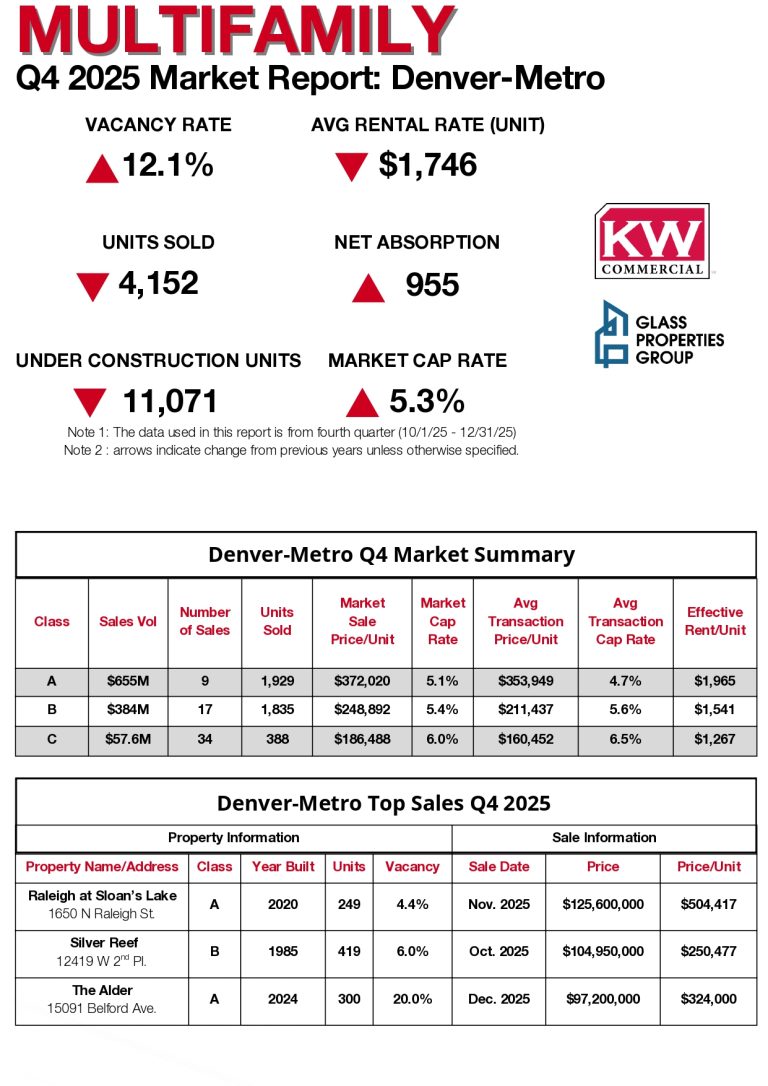
Five key takeaways for the market heading into 2026
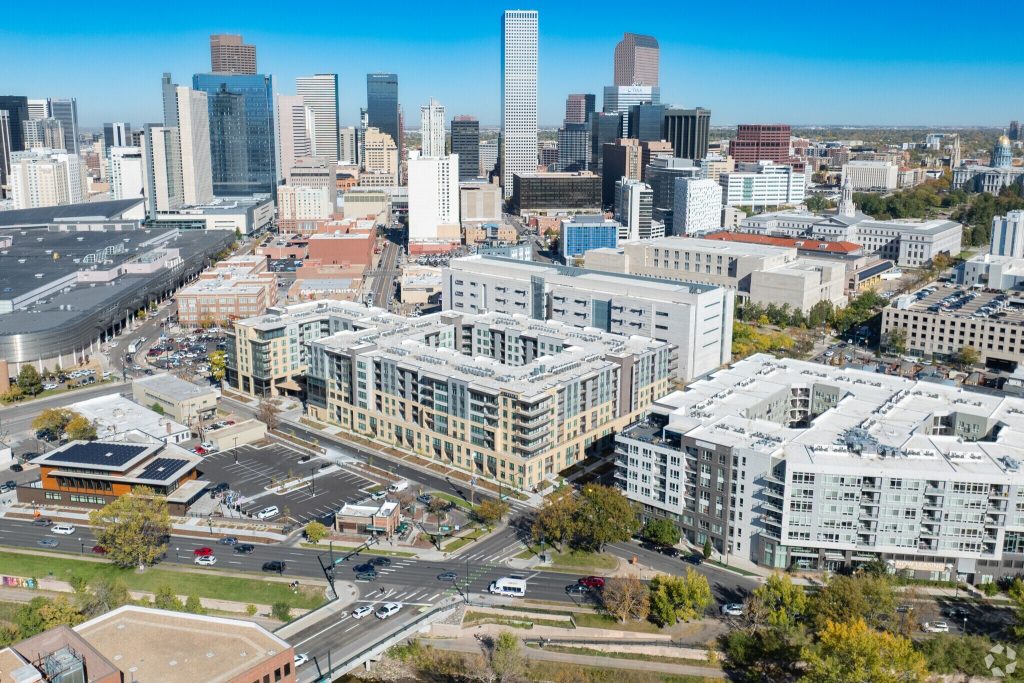
Denver developers completed over 12,000 units in 2025, including the 370-unit The Finch in the city’s Golden Triangle neighborhood. (CoStar)
CoStar Analytics
December 22, 2025 | 9:11 AM
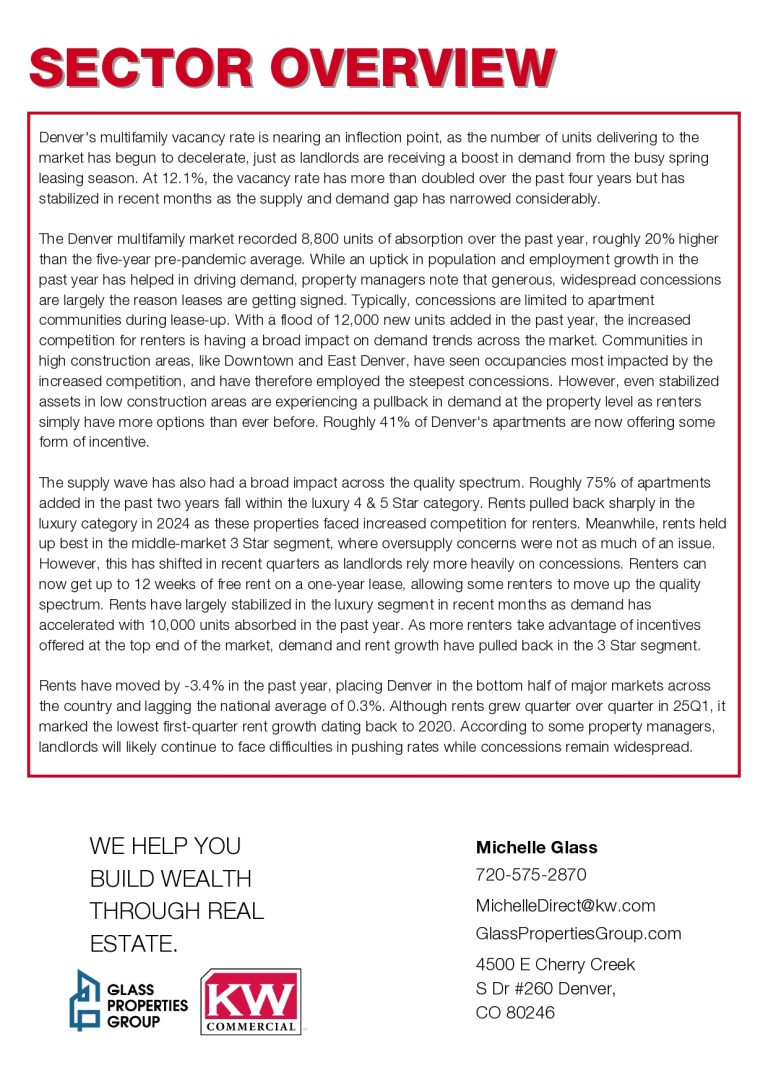
Denver’s multifamily construction wave continues to pummel the market. Vacancies remain near record highs, dragging down rent growth as landlords face increased competition for renters.
However, construction is projected to decline sharply in the year ahead, setting the market up for a gradual recovery.
Multifamily rent growth has been under pressure this year due to an oversupply of units. Denver posted some of the steepest declines among major U.S. markets with rents contracting by 3.9% in 2025, according to CoStar data. Austin, Texas, was the only major market to outpace these rent losses, at negative 4.9% for the year.
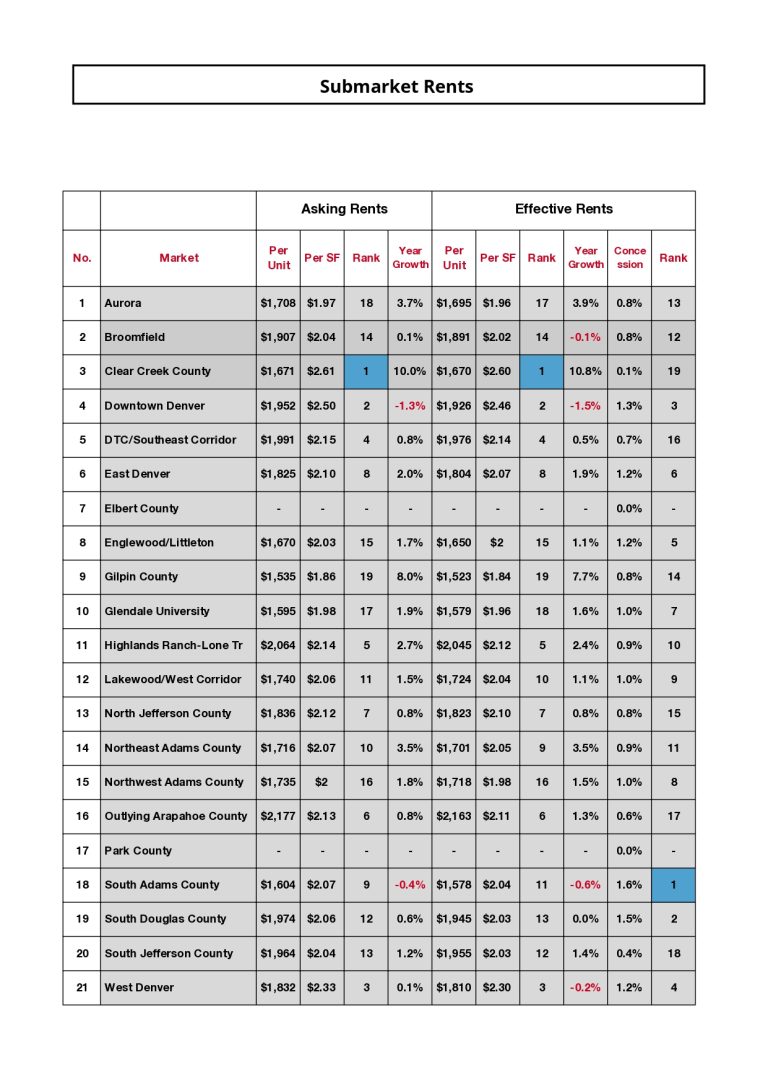
Nearly all areas of the Denver market are reporting negative annual rent growth. The steepest declines are occurring in construction-heavy areas like Aurora and East Denver, where rents are down more than 4% from the previous year.
Looking ahead, CoStar forecasts that demand will outpace new supply in 2026. However, vacancies will likely remain high in the year ahead as the market contends with a significant supply overhang, and rents aren’t projected to return to the long-term benchmark until 2027.
Population growth in the Denver metropolitan area has moderated compared to the rapid expansion of the 2010s, when the region’s economic diversification into higher-paying industries attracted talent from across the country. The slowdown could further slow the apartment market’s recovery.
The region has grown 0.8% over the past year, compared to the pre-pandemic 10-year annual average of 1.6%. Denver’s higher cost of living has tempered growth, and domestic migration has shifted to affordable markets largely in the Sun Belt.
While population growth has slowed in recent years, the region continues to attract a younger demographic, largely due to the area’s outdoor and recreational lifestyle. Roughly 23.2% of Denver’s population is between 24 and 34 years old, according to Oxford Economic data. This younger demographic falls within prime renter years, helping to support demand for apartments.
Property managers note that generous, widespread concessions are primarily the reason leases are getting signed.
A record high 68% of Denver-area apartment buildings offered concessions in November, surpassing the national average of 44%. Renters can expect up to 12 weeks of free rent on a one-year lease in new apartment complexes.
Concessions have also become increasingly common in stabilized properties, or those that are at least 90% leased or have been open for at least 18 months, as property managers focus on shoring up renewals.
Renters of high-end units continue to drive demand. With tenants now receiving up to 12 weeks of free rent on a one-year lease, some renters are taking advantage of the substantial discounts to upgrade their living conditions. Over the past 12 months, net absorption — the difference between move-ins and move-outs — in high-end, four- and five-star buildings totaled 10,000 units, resulting in all positive net absorption in the Denver market. Vacancy in this segment peaked in late 2024 and has since fallen by 130 basis points to 12.8%.
As more renters take advantage of incentives offered at the top end of the market, demand and rent growth have pulled back in midtier, three-star properties. Vacancy in this segment is expected to continue rising through 2026, ultimately peaking near 14.5% in early 2027.
In an encouraging sign for local landlords and property managers, apartment demand in the Denver area is expected to pull ahead of new supply in the year ahead. Roughly 3,700 units are scheduled to open in 2026, marking the lowest level of new supply dating back to 2013.
As broader economic uncertainty mounts, coupled with Denver’s slowdown in population growth, recovery is expected to be slow. Vacancies will likely remain high in the year ahead, and rents aren’t projected to return to the long-term benchmark until 2027.

Despite an interest-rate hike of three-quarters of a percent by the Federal Reserve on Wednesday, and additional increases likely still to come, some housing economists aren’t expecting another big surge in mortgage rates now or in the coming months.
A recent slowdown observed in the U.S. housing market has largely stemmed from the sudden jump in mortgage rates felt in late spring and early summer, in line with the Fed’s decision to move up interest rates in an ongoing effort to combat inflation.
Existing-home sales declined for the fifth straight month in June, down 5.4% from May and 14.2% from the prior year, according to the National Association of Realtors. Unsold inventory was at three months’ supply nationally in June, up from 2.6 months in May and 2.5 months in June 2021, likely attributed to less buyer demand.
Lawrence Yun, chief economist at the NAR, said in a mid-year forecast event by the association before Wednesday’s Fed meeting that the mortgage market has already priced in additional rate hikes, including yesterday’s increase. Plus, fixed mortgage rates are tied to the 10-year Treasury rate, although other metrics, including inflation, are factored in.
“It’s possible that we may be topping out in mortgage rates, independent of what the Fed may be doing in future months,” Yun said.
After an average of 3.45% in January, the 30-year fixed mortgage rate jumped to an average of 4.98% in April, then 5.52% in June, according to Freddie Mac data. More recently, that rate has hovered in the mid-5% range.
That doesn’t mean mortgage rates will completely stabilize but smaller swings up and down are more likely, Yun and others predict.
Mark Vitner, senior economist at Wells Fargo & Co. (NYSE: WFC), said in an email there probably will not be a repeat of the abrupt move seen this past spring.
“There is a growing sense that the Fed is getting close to finishing hiking rate(s), and the markets are expecting the Fed to cut interest rates next year,” Vitner continued. “Mortgage rates have already likely seen their highs for this year but will probably spend much of the rest of the year a quarter percentage point above or below 5.5%.”
Skylar Olsen, chief economist at Seattle-based Zillow Group Inc. (NASDAQ: ZG), also said in an interview mortgage rates will likely be “steady as she goes” for the foreseeable future, even with the additional expected hikes from the Fed.
But if mortgage rates remain somewhat stable, hovering in the mid- to upper 5% range, does that mean the housing-market slowdown that’s occurred in recent weeks in response to skyrocketing mortgage rates will reverse course?Olsen said affordability because of higher mortgage rates and home prices will still be the key hurdle for a lot of households.
“If interest rates can remain stable, then changes and behavior are much more driven by long-term dynamics, which are still solid: a big millennial generation, a boomer generation downsizing,” Olsen said. “There’s a lot in the housing market that’s not going to change as much as (people might) think, but we are absolutely going into a period where the volumes and quantities are going to slow.”

A Message from Glass Properties Group
As we step into a brand-new year, all of us at Glass Properties Group want to take a moment to say thank you.
Thank you for trusting us with one of life’s biggest decisions. Thank you for your referrals, your loyalty, and your belief in our team. And thank you for allowing us to be a part of your journey—whether that meant buying your first home, selling a long-time property, or building long-term wealth through real estate investments.
Reflecting on the Year Behind Us
The past year brought challenges, changes, and opportunities across the real estate market. Through it all, our mission remained the same: to provide clear guidance, strategic insight, and hands-on support—no matter the market conditions.
We’re proud of the wins we achieved alongside our clients:
1. Helping buyers navigate competitive conditions with confidence
2. Assisting sellers in maximizing value through smart pricing and marketing
3. Guiding investors through value-add, multifamily, and long-term wealth-building opportunities
Every closing represented more than a transaction—it represented trust.
Looking Ahead to the Year in Front of Us
The new year brings fresh momentum, new goals, and exciting possibilities. Whether your plans include:
1. Purchasing your next home
2. Selling and repositioning your assets
3. Exploring investment or multifamily opportunities
4. Or simply staying informed as the market evolves
Our team is here to be your strategic partner, your advocate, and your trusted resource.
We’re entering this year energized, informed, and ready to help you make smart, confident real estate decisions—backed by data, experience, and a full-service support team.
Here’s to What’s Next
We believe real estate is more than property—it’s about building stability, opportunity, and long-term wealth. We’re honored to do that work alongside you.
From all of us at Glass Properties Group, we wish you a Happy New Year filled with success, growth, and new opportunities. We can’t wait to see what we’ll accomplish together.
Cheers to a great year ahead! 🥂

If a move is on your radar for 2026, there’s a lot more working in your favor than there has been in a while.
After a stretch where many people felt stuck, 2026 is shaping up to be a year with more balance, more options, and more clarity for people who want to make a move. Not because the market is suddenly “easy,” but because several key conditions are shifting.
Here’s what the experts are saying you have to look forward to.
Danielle Hale, Chief Economist at Realtor.com:
“After a challenging period for buyers, sellers and renters, 2026 should offer a welcome, if modest, step toward a healthier housing market.”
The National Association of Realtors (NAR):
“Top economists have one word to sum up the housing market for 2026: opportunity. Lower mortgage rates and a rising supply of homes are expected to open up the housing market . . . something the real estate industry and potential home buyers and sellers have been waiting for, following three years of stagnation.”
Mark Fleming, Chief Economist at First American:
“. . . for the first time in several years, the underlying forces are finally aligned toward gradual improvement. Mortgage rates may drift down only slowly, but income growth exceeding house price appreciation will provide a boost to house-buying power — even in a higher-rate world. Affordability won’t snap back overnight, but like a ship finally catching a steady tailwind, it’s now sailing in the right direction.”
Mischa Fisher, Chief Economist at Zillow:
“Buyers are benefiting from more inventory and improved affordability, while sellers are seeing price stability and more consistent demand. Each group should have a bit more breathing room in 2026.”
Just remember, while the national outlook is improving, conditions will still be different based on where you live. Some markets will move faster than others. Some will see stronger price growth. Others will remain flat. As Lisa Sturtevant, Chief Economist at Bright MLS, explains:
“Market performance will hinge on local economic conditions, making 2026 one of the most geographically divided markets we’ve seen in years.”
That’s why understanding what’s happening in your specific area is key. The national trends set the stage, but local dynamics determine how they play out for you. And that’s why you need an agent.
If you want more information on what these trends mean for your local market and which trends you’ll want to take advantage of, reach out to a trusted real estate agent.