
Another luxury complex is stretching Denver’s apartment market even further as the city’s record construction pipeline, which already leads the nation, is pushing developers to compete for tenants.
Multifamily giant Greystar, alongside global investment group Ivanhoé Cambridge and PSP Investments, one of Canada’s largest pension investment managers, completed work on a 230-unit apartment project in the city’s Five Points neighborhood, a fast-growing pocket that has attracted the bulk of new construction activity that has landed in the region over the past several years.
Known as The Dorsey, the 13-story property at 600 Park Ave. W touts amenities such as a sun deck, high-end fitness center, coworking and lounge spaces, and a wellness studio, all in a location the development team bets will be especially attractive to prospective renters thanks to its proximity to the local restaurant scene as well as multiple transit routes.
Yet even with perks such as free Wi-Fi for each unit and on-site office space rentals if residents need a separate workspace, The Dorsey is launching in an area that has consistently ranked among the top neighborhoods in the United States for construction activity over the past decade, said Jeannie Tobin, CoStar’s director of market analytics.
The neighborhood’s supply of apartments has ballooned by about 50% throughout that period, and with another 7,200 units still underway, the current pipeline is near an all-time high and will expand inventory by another 12.2%, CoStar projects.
The Dorsey broke ground in April 2021 alongside other projects that collectively are slated to add upward of 4,050 units once completed, according to CoStar data.
Denver isn’t alone in struggling to balance pandemic-era construction booms with waning demand. More than 583,000 new units were completed across the country last year, the highest number of units since the mid-1980s, according to CoStar analysis. That supply burst outstripped demand, pushing the national vacancy rate past 7.5% by year-end 2023 from the 6.5% reported at the start of the year.
Rent growth has slowed significantly as cities struggle to digest the influx of new apartment projects. That is especially true in Sun Belt markets that experienced an unprecedented population boom throughout the pandemic. Rents in both Austin, Texas, and Orlando, Florida, fell by roughly 5% last year, according to CoStar data, and the vacancy rate in Raleigh, North Carolina, jumped from about 8.5% to just shy of 12% over the past 12 months.
Bottom line: Developers with incoming projects are now scrambling to fill them.
From The Dorsey to other recently completed multifamily projects in the city, such as Hines’ 397-unit Mica RiNo and One River North at 3930 Blake St., developers and landlords — especially those with luxury properties — know renters have a lot of options to choose from and are offering concession packages in an effort to win over prospective leases.
About a third of the multifamily properties scattered across the greater downtown Denver area are offering some kind of incentive for new leases, Tobin said. Renters are most likely to find concessions in new construction complexes during the lease-up phase when up to six weeks of free rent has become the standard.
As new construction continues to outweigh demand, however, those free-rent periods are already getting longer and longer. The Dorsey, for example, is offering up to 12 complimentary weeks, according to the property’s website, a significant savings for future tenants considering rents at the Five Points complex are slated to be among some of the highest in the city.
A typical unit at The Dorsey is expected to command more than $2,400 per month, according to CoStar data. By comparison, rates across greater Denver average less than $1,850 a month.
By Katie Burke
CoStar News
Capital is expensive and financing standards have tightened, but for some of the nation’s fastest-growing markets, investors are still willing to chase after multifamily deals.
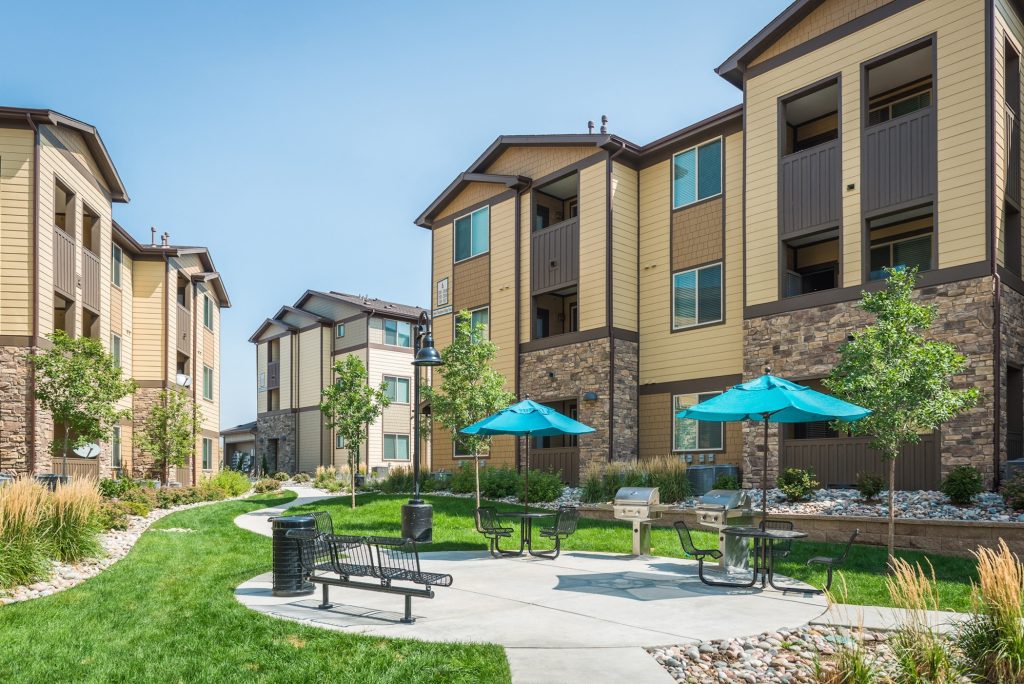
Real estate investment manager Inland Private Capital is the latest seller able to leverage the rising demand after finalizing a $67.7 million sale of an apartment complex it acquired more than half a decade ago in Colorado Springs, Colorado. Northland, a Massachusetts-based real estate private equity firm that has been chasing population growth, was the buyer in the deal for the Estate at Woodmen Ridge complex.
The property at 5520 Woodmen Ridge View is Northland’s second Colorado multifamily acquisition and adds another 260 units to the firm’s expanding portfolio.
While the investment is Northland’s first in the Colorado Springs region, the firm said it won’t be the last.
“We are committed to expanding our portfolio in the region,” Everett Palozej, Northland’s director of investments, said in a statement. “Colorado Springs continues to be a very attractive city for both employers and residents due to the market’s educated talent pool, low cost of living and high quality of life. We see these factors as key drivers of long-term economic growth.”
The deal, which was confirmed by Inland, closed late last month at a price tag just shy of $260,400 per unit.
To compare, the average per-unit price among other multifamily deals that closed in the Colorado Springs area over the past year has been about $237,700 per unit, according to CoStar data. That figure has steadily dropped as a result of the challenged investment climate in which buyers, facing higher borrowing costs and stricter lending standards, have found it increasingly difficult to find deals that can pencil out.
For Colorado Springs, that has meant values have fallen as the cost of debt has climbed, CoStar Director of Market Analytics Jeannie Tobin said, meaning multifamily owners have chosen to hold on to their properties and wait out some of the current challenges.
Higher-end, well-leased properties in prime locations have proven to be an anomaly, however, with buyers proving themselves willing to shell out a premium to position themselves for what they bet will be an imminent rebound.
Los Angeles firm Benedict Canyon Equities, for example, last year dropped $82.2 million to acquire Bellaire Ranch, a two-property multifamily portfolio that included the main 240-unit complex at 4275 Sanders View Drive and the newer Alturas at Bellaire Ranch portion, which has another 60 units at 1130 Bell Tower Heights. The deal shook out to just shy of $275,000 per unit, according to CoStar data.
Alongside a record spike in rents and leasing momentum, Colorado Springs has become especially popular among investors, developers and tenants for its location about an hour south of Denver and proximity to major employers such as Lockheed Martin, United Health Group, Progressive Insurance, Oracle, T. Rowe Price Group and USAA, all of which have fueled the city’s multifamily market.
Rents at the Estate at Woodmen Ridge complex average about $1,775 per month, according to CoStar data, a healthy increase compared to the roughly $1,330 per-month average back when Inland acquired the property in 2017.
The Colorado Springs deal extends a recent buying streak for Northland, which targets regions for their “long-term potential” and focuses on “high-growth, low-tax markets with strong economic trajectories [and] strong affordability and cultural appeal,” according to the firm’s website. Its existing multifamily portfolio spans upward of 80 properties in states such as Florida, Texas, California, Arizona and Minnesota.
By Katie Burke
CoStar News

Unemployment is rising but still historically low, jobs remain plentiful in most industries, wages are up and the economy has withstood blow after blow without rolling over. So why does a sense of gloom pervade about where the economy is at and where it is headed?
Blame inflation and high housing costs for the sense of malaise, said Henry Sobanet, chief financial officer and senior vice chancellor for administration and government relations at the Colorado State University Systems, at the 2024 Economic Forecast hosted by Vectra Bank in Denver on Thursday.
“People feel like their dollar is not going as far as it used to,” said Sobanet, a longtime student of the Colorado economy at both the Colorado Legislative Council and the Governor’s Office of State Planning and Budgeting.
There is also a sense that the state might be entering a different era. Between 1990 and 2020, Colorado enjoyed job gains and population gains topping 70% versus increases nationally that ran closer to 30%. Colorado’s didn’t just run ahead of the rest of the country, it lapped it.
Most of those gains, however, were front-loaded in the first two decades when resources like water and developable land were more abundant, housing costs were lower and the state was perceived as being more business-friendly, Sobanet said.
Growth slowed last decade, even if it didn’t feel like it, and this decade it has come to a virtual standstill. Long accustomed to being an economic leader, Colorado found itself in the uncomfortable spot of being a laggard last year.
“What we had that drove this (growth) might not still be here,” Sobanet said.
Yet, the Colorado economy continues to chug along, despite higher interest rates and inflation, supply chain disruptions, labor shortages, the tech slowdown, and relatively high housing costs.
The ColoradoCast for the first quarter from the Colorado Futures Center at CSU predicts the Colorado economy will continue to grow modestly this year, about 2%, and gain momentum in the coming months.
Slower job gains in 2023 in Colorado indicate that the state is now underperforming the U.S. economy. But after struggling last year, the housing market is showing signs of rebounding.
“If housing in the early part of 2024 continues to regain momentum, the economy can be expected to continue to maintain strength into the year,” according to the report.
Nick Sly, vice president and Denver Branch Executive with the Federal Reserve Bank of Kansas City, noted at the Vectra forecast lunch that inflationary pressures are easing in several areas and that the once tight labor market is loosening.
Fed surveys of employers in Colorado, New Mexico and Wyoming, found that a smaller share, 25% at the end of 2023 versus 60% in 2022, plan wage hikes in the next 12 months. Fewer are looking to expand their workforce and about a fifth of respondents said they plan to shrink it.
A gap has also emerged between growth in hourly earnings and weekly earnings, Sly said, as employers switch away from offering overtime hours and shift more employees to part-time work.
Commercial real estate (CRE) poses one of the greatest risks to continued growth in the U.S. economy this year, Sly said, before unveiling a new CRE index for the region that the Federal Reserve Bank of Kansas City has developed.
The value of the index fell from -0.8 in the third quarter to -1.3 in the fourth, with a reading of zero indicating activity that matches historical norms. The index got as low as -2.5 during the financial crisis in 2008 and took a hit early in the pandemic before rebounding.
The index covers office buildings, which facing unprecedented weakness; apartments, which are peaking out; retail space and hotels, which have rebounded since the pandemic and industrial, which remains strong but is slowing.
As office leases roll over, tenants are leaving or asking for less space and demanding lower lease rates, which is putting additional pressure on landlords. Local and regional banks have a heavier concentration of CRE loans in their portfolios than the large national banks, which leaves them vulnerable as well.


WINCHESTER EQUITIES
Municipalities have long used incentives to spur investments they hope to see in their cities, or to solve for a persistent problem they’ve deemed requires private-sector participation.
Now, city officials are introducing or expanding upon programs to encourage office-to-residential conversion projects in America’s downtowns in the wake of a weak post-pandemic office market. With the national office vacancy rate hitting a record 19.6% at the end of the fourth quarter, and a key source of tax revenue dwindling as office building values decline, it’s become a top priority for elected officials and economic developers to figure out how to make more conversion projects happen.
The projects aren’t easy.
Based on physical characteristics alone, it’s estimated that 60% of office buildings are poor candidates for conversion to residential use, according to a 2021 algorithm developed by design and architecture firm Gensler. There’s also the state of financing on the building in question, the kind of investment that’ll be needed to bring the building to a new use, and how much a nearly empty office building could trade for. Developers frequently say it needs to trade at a deep discount if it’s earmarked for conversion.
Still, the desire to see more housing — and to see obsolete office buildings reimagined to make them revenue-generators once more — is top of mind nationwide. Affordability continues to be a serious challenge for homeowners, with the monthly mortgage payment on a typical U.S. home up 96% from early 2020, according to Zillow Group Inc. data. That’s thanks to rapidly rising mortgage rates since 2022 and record-high home-price appreciation during the pandemic. And, while the rental market has slowed, many U.S. metros saw double-digit percentage gains in rental-housing costs during the pandemic, and a record-high 22.4 million renting households are considered cost-burdened.
To spur office conversions, mechanisms like tax-increment financing, tax abatements and tax waivers are being proposed or are already in play in cities across the country as ways to reduce the cost of converting office buildings into housing or other private-sector uses, such as a hotel, lab or data center
While incentives are typically viewed as deal-sweeteners, those working on conversion projects today argue they’re more of a necessity than a bonus for a lot of conversions to make sense, especially given the current capital markets.
“It’s absolutely critical,” said Steven Paynter, building transformation and adaptive-reuse leader at Gensler. “There are very few other options to getting these projects moving at the moment at any kind of scale. The high interest rate on, especially, construction lending … is a dealbreaker for the projects.”

CBRE Group Inc.’s data on conversions shows an uptick in the number of office conversions underway nationwide since the Covid-19 pandemic but no evidence of a windfall, said Julie Whelan, global head of occupier thought leadership at CBRE.
“We know more housing is needed,” Whelan said. “It’s just that fulfilling that demand in the way that it needs to be fulfilled is very difficult to make work when you’re putting numbers down on paper.”
The Goldman Sachs Group (NYSE: GS) had similar findings in a recent analysis it did on the financial feasibility of converting office buildings into residential units. It found about 0.4% of office space had been converted into multifamily units on an annual basis before the pandemic, which rose only to 0.5% in 2023.
In many conversions, either the housing being added into a former office building has to rent or sell at a certain price (usually top-of-market), or the upfront basis — the cost of purchasing the building — has to be low enough that the project makes sense financially, Whelan said.
That’s difficult in many cities because office building trades haven’t necessarily reached those ultra-low levels yet. So, without aggressive incentives at the municipal level, a lot of conversions won’t pencil, Whelan said.
At the same time, she added, most downtowns aren’t lacking in luxury housing. Instead, affordable housing is what’s badly needed, and that usually requires some degree of subsidy, even for a traditional, ground-up development.
Goldman Sachs, using a discounted cash-flow model, also found current acquisition costs for struggling office towers are still too high for a conversion into a multifamily building to be financially feasible because of how much it costs to do that conversion.
Nationally, the average price of what Goldman deems as nonviable office buildings — those built before 1990, haven’t been renovated since 2000 and have a vacancy rate higher than 30% — has fallen 11% since 2019. In the hardest-hit cities, average transaction prices have declined by 15% to 35%.
If an office building is acquired for $307 per square foot (the average transaction price of nonviable offices, according to Goldman’s model) and the cost to convert it to a new use is $280 per square foot (slightly above average for a typical conversion cost), that project would result in a $164 loss per square foot if high-end multifamily units added in that building are rented at $4.50 per square foot. That means current office prices would need to fall by about 50%, or about $154 per square feet, for conversion costs to pencil, according to Goldman.
On the financing side, there’s a limit right now on banks’ willingness to lend to commercial projects, Paynter said. He added that the risk tolerance among lenders to take on conversion projects, which can come with unexpected costs and delays, has also been diminished.
Many capital sources won’t invest in a conversion until it’s significantly underway or close to completion. A five-story office building in downtown Newark, New Jersey, that’s being converted into a 92-unit residential development recently obtained a $22 million loan from Northwind Group. It was underwritten at the 70% or 80% completion stage, said Ran Eliasaf, founder and managing principal at Northwind.
“A conversion is a complicated execution,” he said. “It typically takes longer and costs more than what developers underwrite.”
Federal incentives available for conversion projects
In October, the White House issued guidance on how existing federal programs could be leveraged in the conversion of office buildings into other types of development, especially housing. The guidance includes programs from the Department of Transportation, the Department of Housing and Urban Development, and the General Services Administration.
Developers say while the programs are a good start, being able to put those incentives to work is another matter.
Paynter said the spirit of the guidebook is a good one, but there are a lot of fine-grain details and challenges in figuring out what the rules are for applying those programs to conversion projects.
“Because these programs weren’t really set up to deal with housing creation, there are some oddball requirements,” Paynter said. “It’s not as simple as everyone had hoped.”
Some developers are concerned about how long it might take to put that capital to work even if their deals qualify for any of the programs.
Since the pandemic, Keystone Development and Investment has waded into the conversion game. The West Conshohocken, Pennsylvania, company historically has been a significant office investor. It recently completed a conversion of the historic Curtis building in center city Philadelphia into life sciences space. It now is pursuing a conversion of several floors at The Washington — another historic building in Philadelphia — into luxury housing, in addition to converting a suburban office building it owns on a mall property in Plymouth Meeting, Pennsylvania, into housing.

KEYSTONE DEVELOPMENT AND INVESTMENT
Michael Brookshier, vice president of development at Keystone, said the company to date has leveraged traditional tools such as state historic tax credits for its conversions. But with higher interest rates and construction costs, new and different types of incentives are being considered by the developer.
Among the incentives offered in the White House guidance, Keystone is considering two DOT programs. Brookshier said that’s primarily because those programs don’t carry an affordable-housing requirement — Keystone is developing market-rate housing in its conversion deals — and many of the firm’s properties are close to mass transit, with the DOT programs specifically intended to incentivize new housing near transportation.
Echoing Paynter, Brookshier said because the programs are newly being used for housing conversions, everybody is still figuring out how they’re going to work. And with 2024 being a presidential election year, there’s potential risk the programs could go away if there’s a change in administration after November.
But the biggest challenge Brookshier sees with leveraging federal incentives for conversions is the time it could take for them to be deployed for projects his firm is pursuing right now. From letter of intent to closing on the financing, that could take 12 to 18 months, he said.
“I have a project I’d like to close on in March and June of this year, so [that] doesn’t work from a timing perspective,” Brookshier said. “On the flip side, there are projects I’d like to build in the future, so maybe I should get the application in so I have things in process … but at that point, you’re predicting the future.”
It also would be useful if there were one simple process to submit applications for federal incentives being offered, Paynter said.
Eric Stavriotis, vice chairman of advisory and transaction services and leader of the location incentives group at CBRE, said it’s most helpful when a developer can sift through a basket of incentives to figure out which ones make the most sense for their particular project. That could range from a tax-increment financing structure to the ability to use city transportation dollars at a former office site so as to make the property more accessible for residents instead of daytime office workers.
From conversations with CBRE clients, Stavriotis said it doesn’t seem the federal guidance alone is spurring deals.
“The old axiom applies here: All politics are local,” Stavriotis said. “Most of what we’re seeing nationally is that the assistance that is moving the needle for a developer — usually a private developer that’s looking to do a project — is oftentimes more local in nature than federal.”
Federal money can be an important part of a project capital stack, but many of those funds are channeled through the state or local level, even if it has federal origin, Stavriotis said.
Local and state officials propose incentives
San Francisco arguably has one of the nation’s bigger office-market problems. That metro’s office market ended 2023 with an eye-popping record-high vacancy rate of 35.6%, according to CBRE. Yet conversions haven’t taken off in San Francisco, even with 12 out of 36 buildings in the city’s downtown having been identified as good candidates for conversion, according to a 2022 study by Gensler.
Local developers and land-use attorneys say a number of initiatives have been proposed at the state and local level to try and spur those projects, but more is needed.
“This is classic economic development,” said Jack Sylvan, founder and principal of SDG LLC and the director of think tank San Francisco Bay Area Planning and Urban Research Association (SPUR). “The public invests in order to catalyze the private development, and that’s what San Francisco needs in this moment.”
Voters earlier this month were asked to weigh in on a measure known as Proposition C. If approved, the measure would waive a San Francisco transfer tax for projects that convert office buildings into housing.
But even before the vote, Prop C was deemed in an economic-impact report by the city controller’s office to be a largely insignificant measure to spur conversions. It determined the cost savings from waiving the transfer tax for those projects would be worth about $33,500 per unit for apartment projects and $9,000 per unit for condo projects, the San Francisco Business Times reported. It also projected it would take the city 29 years and 102 years, respectively, to recoup the revenue it foregoes from waiving the transfer tax in those projects.
As of last week, the outcome on Prop C was still too close to call, although “yes” votes had a slight edge.
Speaking ahead of the March 5 voting, Sylvan said it’s not that waiving the transfer tax itself will lead to a lot of conversions. Rather, it’s just one of many tools needed to make conversions feasible.
Sylvan said he’s estimated that between legislation passed by the city of San Francisco last summer that streamlined planning requirements and Prop C, if it were to pass, those measures would solve about one-quarter of the feasibility gap per unit in conversion deals. SPUR estimates there is a current feasibility gap of $267,000 per unit.

Another measure being closely watched in San Francisco and elsewhere in California is at the state level.
California Sen. Scott Wiener last month introduced State Bill 1227 that would give developers converting office buildings into new uses in downtown San Francisco a temporary exemption from the state’s Environmental Quality Act and also would expand a tax exemption for those projects from strictly affordable housing to also include workforce housing.
Sylvan said the measures collectively “are no silver bullet” but they start to unlock the potential for projects to begin and for capital to be reinvested in downtown San Francisco real estate.
“If you’re waiving fees, you’re waiving fees that would never be charged because nobody is doing anything with that building,” Sylvan said. “It’s basically foregoing [a tax] that [the city] would never have collected. It doesn’t exist but for the conversion.
“To me, that’s the most important piece of the policy conversation,” he said. “Yes, you are providing an incentive, but the city isn’t giving anything up because it wasn’t going to get anything [if] a building sits [empty].”
Conversions call for more than incentives
Beyond financial considerations, San Francisco is not unlike other U.S. cities in having inclusionary housing requirements that Sylvan said could be a barrier for conversions. That means even if more incentives become available, it could still be a challenge to get conversion deals done without policy changes, he said.
Other requirements can add cost and risk to conversion efforts. For example, converting an office building to a residential use may trigger earthquake-related code requirements, which could necessitate significant seismic upgrades, said Caroline Chase, a partner at law firm Allen Matkins Leck Gamble Mallory & Natsis LLP, who specializes in land-use law.
“That would likely include a substantial seismic upfit [and] that could hinder projects from moving forward,” she said.
She added that SB 1227 has prevailing-wage and skilled/trained workforce requirements associated with it that could create challenges and added costs for construction workforce.
The hurdles to converting office buildings in San Francisco into new uses are but one example in one city — albeit one of the more challenging markets to turn obsolete office inventory into new uses. But what’s stymying projects there illustrates how policy and regulation change are a significant piece of the puzzle in getting conversions anywhere in the U.S. across the finish line.
In some places, it’s simply how long it takes to get a project through a city land-use and planning department. Those focused on downtown revitalization and development say making that process more streamlined is one way to get projects approved quicker and provide greater certainty to developers embarking on already risky conversion deals.
Nolan Marshall, executive director of the South Park Business Improvement District in Los Angeles, said in a recent interview a lot of municipalities have struggled to streamline their regulation process.
“You have to disentangle the process and make it easier for people to get permits for capital to flow in your community, and flow in a fast way,” Marshall said. “It’s challenging enough to figure out how to do a conversion from an office building to a residential building. If it takes a developer 12 months in L.A. — and that’s being optimistic — [and] it takes them five months in Austin, Texas, that capital will flow to Austin, Texas.”
Paynter said state and local governments have the ability to move more effectively and quickly than the federal government, even if they are smaller-scale efforts. But in many places, he said, local programs on the whole are overly complicated.
Both Paynter and Whelan cited Calgary, Alberta, Canada as an example of a government with a relatively simple conversions program, including the clarity that’s provided around incentives.
Calgary says it currently has 13 office buildings actively being converted, and four under review, into new uses. In cities across the U.S., there were only 42 office conversions actively underway in September that were expected to be finished in 2024, according to CBRE.
“In talking to developers, the two terms that come to mind are certainty and ease,” Whelan said. “The lack of certainty in this whole process, given the risk and expertise associated with these projects, is holding some developers back from doing these projects.”


